Product authentication
Use unique IDs and scannable codes for inspection and verification workflows.
New: TFORMer Designer V9.2 — easily design and print labels and forms. Explore the product →

Traceability
GS1 DataMatrix, HIBC and managed serial pools for UDI, FMD and audit-ready marking.


A failed print can't simply be reprinted — a duplicate serial breaks uniqueness and leaves an audit gap. TEC-IT manages serial pools centrally and marks to ISO/IEC print-quality grades, so every unit carries one verifiable identity.
Centralized serial pools and correct AI encoding produce codes that verification systems accept.

Use unique IDs and scannable codes for inspection and verification workflows.
Track products, batches, assets and documents across process steps.
Create repeatable labels from controlled data and templates.
Finning Chile
“Scan-IT has transformed how our teams work in remote mining environments. We can now capture barcodes, photographs, and component data in real time — even offline. The solution ensures full traceability, faster claim validation, and complete transparency across our operations.”
Waldo Vasquez Parga, Technology Leader, Logistics & Warehouse Area, Finning Chile
Read customer story ›Serialisation, data and printing as one system.

Serialised, aggregated layouts are designed once and reused across every packaging level.
Every serial is checked for format and uniqueness before it is committed and printed.
Serialised print jobs run centrally with full audit trail — on printers, as PDF or via API.
Every solution maps to proven, licensable products.
Generates 100+ barcode symbologies in .NET, C++ and COM applications.
Designs label layouts with data fields, serial numbers and barcodes.
Sends mobile barcode scans straight into Excel, Word and Google Sheets.
Reliable infrastructure
Centralized serial pools and correct AI encoding produce codes that verification systems accept.
Each serial is issued once and provably unique.

Numbers are drawn from a controlled pool — the engine never repeats one.
Every serial is checked against issued history before it is printed.
Item, bundle and case all link back to the same issued identity.
How companies run identification, labeling and data capture on TEC-IT software – in production, logistics and IT.
Learn more about Security & Traceability.
For prescription medicine packaging, there are new imitation protection guidelines, which is called EU Falsified Medicine Directive (EU FMD, 2011/62/EU). According to delegated regulation 2016/161/EU the products are identified by a 2D barcode and contain a unique product number as well as other security features.
The following product features are encoded in the GS1 DataMatrix:
The data string for the Data Matrix consists of:
01 + NTIN (14 digits) + 17 + Expiration Date (6 digits) + 10 + lot number + \F + 21 + serial number
Example (without NHRN):
0104150103893583171714112010KMB11205201\F21CEB630078700
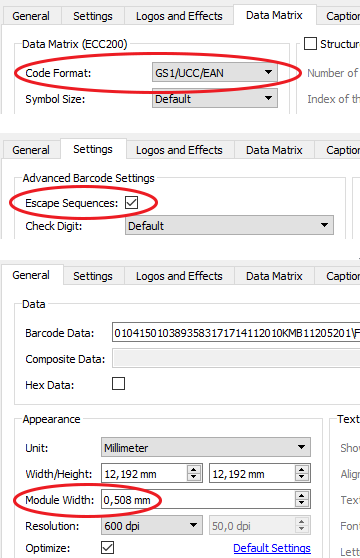
The following barcode parameters have to be configured (see pictures):
You can find a preconfigured Barcode Studio BC file here.
Unique Device Identification (UDI) is a worldwide system to uniform product labelling for medical goods. UDI serves as a key to a UDI database (Unique Device Identification Database; UDID), which contains a number of product information. The products and packaging receive a UDI data carrier which contains the identification number. For the UDI carrier the barcode types Code 128 and Data Matrix (ISO/IEC 16022) are used.
EU UDI Requirements
All medical goods and in-vitro diagnostics must be clearly identifiable worldwide.
UDI Device Identifier (UDI-DI)
The UDI-DI is a unique numeric or alphanumeric code which identifies the article (static data). Within the GS1 system, the GTIN (Global Trade Item Number) is used for the UDI-DI.
UDI Production Identifier (UDI-PI)
The UDI-PI enables traceability with data such as batch, expiration date, serial number (dynamic data). Within the GS1 system, the corresponding GS1 Application Identifiers are used.
Basic UDI-DI
The basic UDI-DI is the primary identifier of a product type, which is assigned at the level of the usage unit of the product. It is the most important classification characteristic for data records in the UDI database and is shown in the EU declarations of conformity. The Global Model Number (GMN) can be used in the GS1 system to implement the basic UDI-DI.
UID Codes are used as a permanent marking method in order to give equipment a unique ID. UID Codes utilize the Data Matrix ECC200 bar code symbology - this standard is supported by TEC-IT.
Beside selecting Data Matrix as bar code type the encoded data structure has to comply with the rules outlined in the „MIL Std 130“ specification (see also this FAQ).
More details:
Creating the world wide unique UID number can be achieved by the following methodologies (constructs) and approved equivalents:
Accepted Issuing Agencies:
After getting a world wide unique enterprise ID from one of the listed Issuing Agencies, suppliers can number their products with UID Construct 2. Often an existing serial number management can be re-used for that process. Suppliers in the US can use the CAGE code as enterprise ID. In other countries the NATO or GS1 can issue enterprise IDs. If a company already owns a DUNS number it can be used as well.
Using timestamps is a workaround if you cannot use persistant serial fields. The following expression creates a 12-digit alphanumeric timestamp for a unique package ID (incremented with each print job).
CStr(Chr(65 + Year(Now()) % 26)) +
CStr(Chr(65 + CLng(Format(Now(), "MM")) - 1)) +
CStr(Chr(47 + CLng (IIF (Day(Now()) >10, 7, 0)) + Day(Now()))) +
CStr(Chr(65 + Hour(Now()))) +
Format(Now(), "mmss") +
Format(PrintedItems, "0000")
Put this expressions into a calculated field like clPackageID (data type Text). If you use individual label copies calculate it per Record Copy.
With 8 digits, we can remove the year and the seconds and limit the serial part to 3 digits.
CStr(Chr(65 + CLng(Format(Now(), "MM")) - 1)) +
CStr(Chr(47 + CLng (IIF (Day(Now()) >10, 7, 0)) + Day(Now()))) +
CStr(Chr(65 + Hour(Now()))) +
Format(Now(), "mm") +
Format(PrintedItems, "000")
This auto-package id consists of a 5-digit timestamp (month/day/hour/minute) followed by a 3-digit sequence number. That means the number of items/pallets in one job is limited to 999 and the minimum time between print jobs must be 1 minute. The package id can repeat itself every year.
Data Matrix ECC200 explained: symbol sizes, encoding modes and industry applications.
GuideThe GS1 Application Identifier reference: structure and meaning of the AI fields.
Customer storyAudit-traceable barcode output backs controlled processes across a demanding enterprise data stack.
Try it free in the browser, download a full trial, or talk to sales about your systems, standards and volume.
We use cookies for marketing and to improve your experience. Read our Cookie Policy or manage cookies.